This legacy continues to have an impact today. In recent decades, many church-affiliated organizations—including Connexio hope and develop—have begun to critically examine and change this approach. Merely giving is increasingly being replaced by a partnership among equals: Local organizations set their own priorities, knowledge flows in both directions, and the role of Connexio hope and develop is shifting from that of a doer to that of a companion. This development is not yet complete. It requires continuous self-reflection and the courage to admit one’s own mistakes.
Those who work in fragile contexts do so amid uncertainty. Political instability, changing conditions, cultural misunderstandings, and logistical hurdles characterize such an environment. Misjudgments are not the exception here, but rather an integral part of the work. A project that looks promising on paper can fail on the ground due to unexpected factors.
This is not an excuse for negligence, but a realistic starting point. Anyone who pretends that everything always goes according to plan loses credibility. Mistakes aren’t the problem—they only become problematic when they’re concealed or glossed over instead of being used as learning opportunities.
Collaboration thrives on trust—in local partners, in the people involved in the projects, and in the donors who make this work possible. Trust isn’t built by an organization appearing flawless, but through honesty: both in times of success and in times of setbacks.
In concrete terms, transparency means: openly addressing difficulties rather than hiding them; making the use of resources transparent; and reporting even when a goal has not been achieved. Where transparency is lacking, mistrust arises—and mistrust is ultimately more costly than any admitted mistake.
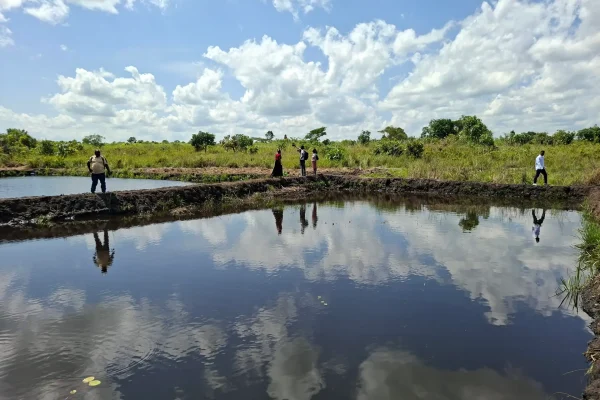
This is particularly evident in areas where things didn't go smoothly. In the fish-farming project that Connexio develop launched a year and a half ago with a partner organization in Kamina, in the Democratic Republic of the Congo, the first year of the project failed not because of the technical concept, but due to a lack of communication. Finding a suitable piece of land for the fish ponds that was easily accessible to the project participants proved more difficult than expected. Subsequently, construction materials were stolen—which delayed the actual implementation of the project by several months, without Connexio being informed. As a result, not all of the planned activities could be carried out during the first year of the project.
When the Connexio develop program team did not learn of this until toward the end of the project year, it severely undermined trust in the collaboration and raised doubts about the project partner’s capabilities. After a visit by the country coordinator to the site and intensive discussions, it became clear that Connexio develop had not clearly defined the communication requirements. Connexio develop therefore decided to give the project another chance.
.
«This experience has reminded us that, when embarking on new projects—especially when collaborating with new project teams—the dynamics of the partnership must first be established,» says Blanchard Ayinza Boke, the national coordinator for Connexio develop. «This involves ensuring that the team has the capacity to successfully carry out the project, fostering a culture of learning, and strongly encouraging partners to communicate not only about successes but, above all, about failures and mistakes.» Especially during the initial phase, it is important to articulate expectations more clearly and to hold partners accountable. At the same time, it’s important to make it clear that this isn’t driven by mistrust, but rather by the desire to build a trusting relationship. This requires an even more intensive exchange at the outset than it does after years of well-established collaboration.
Despite the efforts on both sides, this remains a challenging task, as intercultural misinterpretations and misunderstandings are part of everyday life in international cooperation. We cannot, therefore, expect that such situations—or similar ones—will never recur; rather, we must continually strive to deepen our partnership through mutual, regular, and transparent communication.
Learning from mistakes is therefore more than just a good intention: it requires a culture that makes this possible. This includes allowing mistakes to be identified without immediately assigning blame. It also means that ConneXio’s leadership, together with its partners, investigates why something did not work. And that the insights gained are incorporated into future collaboration.
A healthy culture of accountability is not a sign of weakness, but of maturity. It does not make Connexio develop more vulnerable as an organization, but rather more credible. And it is deeply rooted in Connexio’s core identity: Anyone who takes partnership on equal terms seriously must also acknowledge their own fallibility. Perhaps this is the most important shift from the past: no longer the attitude of thinking we know better, but rather the willingness to learn together.
International cooperation works!
The Federal Council is sharply cutting funding for international cooperation. This means the loss of funds that are desperately needed to combat hunger, poverty, and disease. Millions of people are affected.
So become part of the international community and help where it is needed most.